


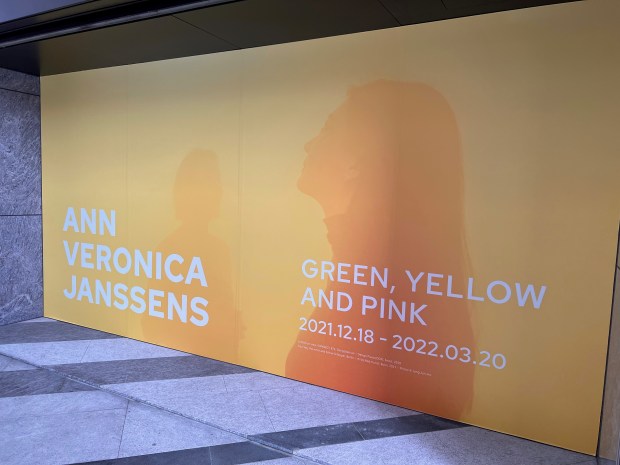
The 21/22 winter at Taipei Taiwan was less but monotonous as Winsing Art Place puffed soft pastel air on the art-enthusiasts of the city. The solo exhibition “Green, Yellow and Pink” began on December 18, 2021 and ended on March 20, 2022. The exhibition featured a small selection of Veronica Van Janssens’s artwork: Bright Pink & Yellow, CL9BK, Untitled, and Green, Yellow, and Pink (2017). The brief selection of works overviewed the artist’s interest to explore the idea of light and color through ephemeral mediums.
The first two works of art at the exhibition are three glass sculptures from ‘Gaufrette’s’ series: Bright Pink and Yellow, CL9BK and Untitled. The color and texture of these sleek sculptures are dependent on viewing perspectives. A rectangular glass log Untitled appears either totally transparent or blue depending on viewing perspectives. Behind the glass log is CL9BK, a piece of textured glass tinted with washes of yellow, green and red, leaning to the pale white wall. In this space, the works appear a bit with every glimpse, showcasing the artist’s interest in the intangible elements such as light, color and space.
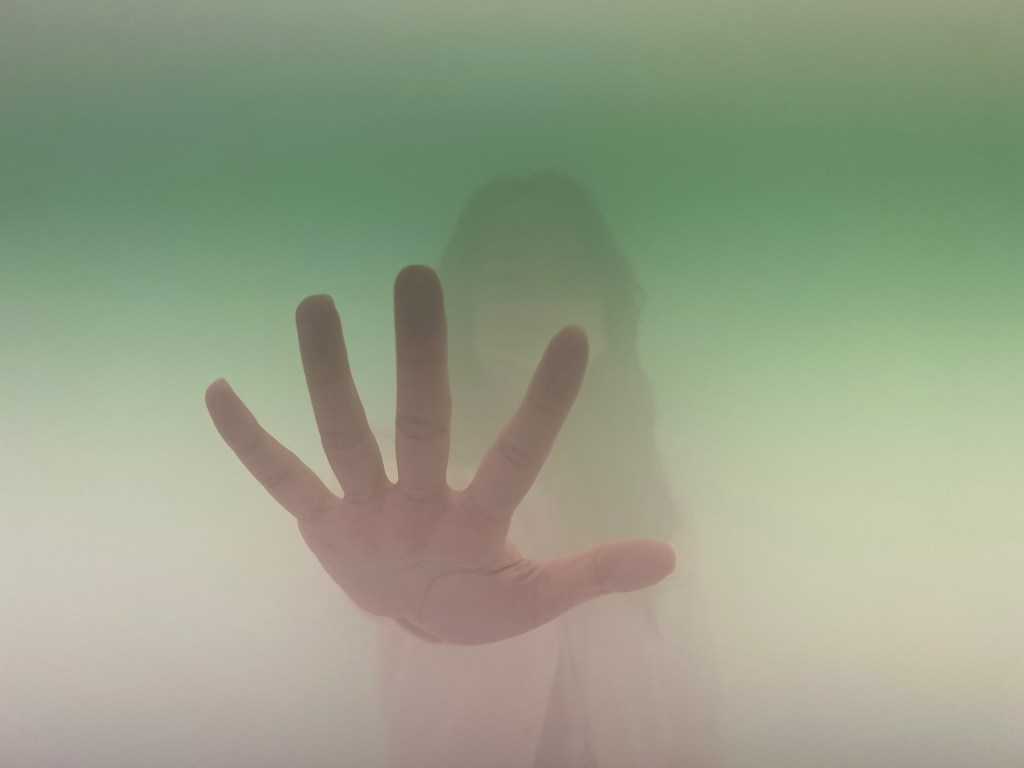
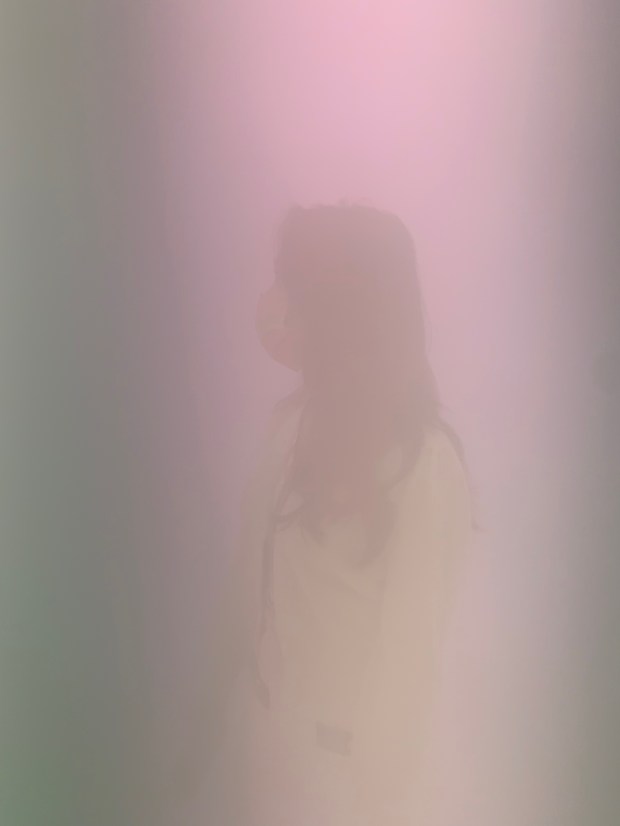
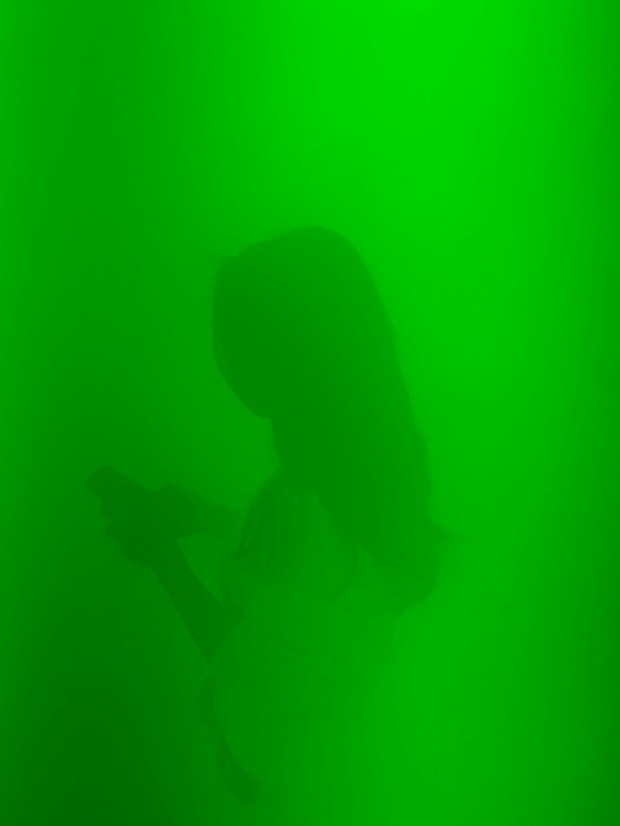
The star of the Wingsing Art Place was Green, Yellow, and Pink (2017), the artist’s renown site-specific fog room. In this work, the white cube was filled with milky haze, which allowed the colored light to diffuse evenly in the space, creating an immersive dreamlike environment of color. Janssens created Green, Yellow, and Pink (2017) for her solo exhibition at Esther Schipper in 2017.
Beside light and color, the idea of space is another theme in Janssens’ fog room. The senses of space and distance are undermined in the room where anything two steps away disappears into the colored fog. The floor, walls and ceiling become incomprehensible. The immersive environment reduces distractions and allows the visitor to focus on the work itself. The participants are only able to see and sense the artwork, nothing else. The familiar everyday elements, air, light and water, perform an ephemeral and intangible show that stimulates the perception, spatial sensation and sense of direction.
In the fog room, the participant becomes aware of senses beyond the eye sight but also the sense of physical space and physical presence.
Unlike most visual artists who fill the canvas with rich visual elements, Ann Veronica Janssens works the opposite. An empty room, some fog, and color lighting are choreographed to show a unique immersive environment. The work does not hold still for viewing, instead the participant should walk around and be in the work to experience and even breathe the artwork.
Another artist who incorporates light and air into his practice is WangShui. Currently at the Whitney Biennale, WangShui’s posthuman AI programmed work is a reflection of the light and air of the exhibition space. The abstracted forms on screens and on aluminum panels surround the visitors and create an organic yet futuristic environment. It is if the work is able to sense the air quality and luminous level just like living beings. Alive, evolving, undergoing chemical balances just like humans. When air, light and even water are incorporated into the creative process, it is if the artwork has come to live.
In a world where NFT compete its place in the paradigm of art, I believe art is more than collectible as it always have been. Art should arouse our emotional, physical, or metaphysical senses just like Ann Veronica Janssens and WangShui do in their works.
Ann Veronica Janssens was born in the United Kingdom in 1956. She now lives and works in Brussels, Belgium. She attended La Cambre National School of Visual Arts in Brussels. Janssens became known for her immersive mist room in 1999 after Janssens and Michel François represented Belgium at the 48th Venice Biennale. She later installed other mist rooms such as Blue, Red, and Yellow (2001) and Green, Yellow, and Pink (2017). Janssens uses materials such as air, light, glass and mirrors to challenge the idea of perception and space.
 Jenniyo. Artchive and Blog
Leave a comment